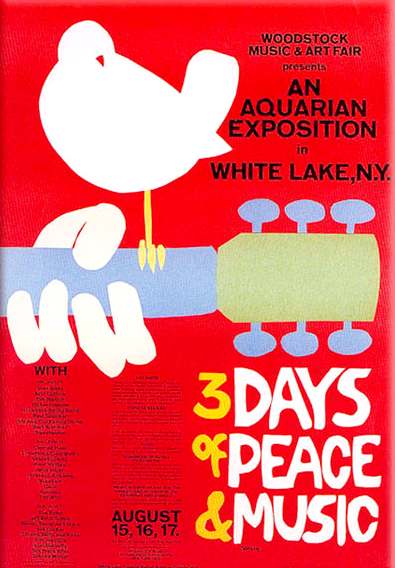
For NHD this year I wrote a Historical Paper on Woodstock '69. This was my second year doing a paper, so I knew exactly what was expected and how to handle myself while conducting my research and writing my paper. However, I honestly believe that last year, my paper on Hall & Oates was way better.
The overall turnout of my paper was just okay. For me the length could have been longer, and I could have used more of my opinions toward the festival than facts for just about everything (even though that did make my primary source list long).
I believe the hardest part of writing any paper, is taking all the information and research you have and organizing it into a paper. During workshops, I became frustrated sometimes because I was still in the process of orgainizing what I had instead of actually typing my paper.
When I finally finished my paper, I had a total of 2,479 words, almost meeting the maximum and about 11 pages including the interview.
For me, this year the best part of my NHD experience in writing a paper was the interview I conducted with Terry, the owner/creator of the amazing site www.woodstock69.com
She helped me out a lot and my interest for the event grew as you told me of her experience and what the youth in her time stood for.
Throughout this whole experience I learned so much I would never have thought that would have happened at a concert. Now I realize how legendary and successful the event is and why up to this day is still talked about and completely legendary.
I would never forget this project because it was interesting and a project I recommend to anyone whose interesting in learning about Woodstock and the 70's era in general.
After all, Woodstock lives on!
Monday, February 25, 2008

Thursday, February 21, 2008
Char Notes:

Chapter 4 (24-28) "I Aint Neva Scared!"
Summary
This chapter is about Bigger and Gus arguing with going through the robbery at Blum's. They argue for a while showing that they aren't afraid of one another but definitely afraid of robbing a white man. Bigger picks on Gus because he reveals his fears by admitting it, but Bigger hides his by the toughness of the streets.
Analysis
I believe Richard Wright wrote this part to show how young black males act when "the streets" are apart of their upbringing. He portrays this in Bigger, by showing that black males were supposed to act tough even if they were scared of a situation.
Chapter 9 (66-70) "After All, I'm On Your Side."
Summary
This chapter is about Bigger's encounter with Mary during his first day of driving her. He is told that she has to be driven to the University and picked up there. However, in the midst of driving her, she tells him to loosen up with her and turn the car around. From there, she goes to pick up her friend Jan, an invites him in the car with them. They both become friendly with Bigger and shows him not every white person is cruel and out to get black people. Jan then begins to drive while he questions Bigger, and they later go get a bite to eat.
Analysis
I think Richard Wright wrote this part to show, as I said before not all white people are cruel and they do think of black folks as equals, however some colored people take it the wrong way and are a bit scared to become comfortable with them.
Chapter 11 (82-85) "Accidental Death?"
Summary
This chapter is about Bigger accidentally killing Mary in order to keep her out of trouble and keep his job. He brings her upstairs, because she is unable to walk on her own, then violates her by feeling her up until Mrs. Dalton (who is blind) enters the room. When she call for Mary, Bigger puts the pillow in her mouth so she can't make any noise. Mary fights back until she can't breathe anymore, because she was over powered by Bigger's strength.
Analysis
Richard Wright, does this to give the book some intensity. He shows how some people would react in the heat of the moment, and how far some people would go to protect themselves. Also, he puts this part in the book to show how possibly some black men felt toward white women in that era, also how people are taken advantage of when drunk!
Friday, February 1, 2008
"Reluctantly"

Reluctantly; describes disinclination toward something.
Synonyms; unwilling, disinclined.
Antonyms; willing
Ex. The child was reluctant to take a bath.
Tuesday, January 29, 2008

Friday, January 4, 2008
Topic Essay; Woodstock

"The largest rock concert ever conceived was coming to town... Three days, not hours, of Music... Camping out under the stars... This was going to be a "serious" party!! Upstate New York was ready. The city, county, and state officials knew what to expect and felt confident in their abilities to handle traffic, crowd control, sanitation, medical emergencies, and any unexpected problems. They were prepared."
August 15-18th would definitely make history and days to remember. Woodstock was a music and arts festival held at a diary farm in the rural town of Bethel, New York.
To many, the festival portrayed the culture of the 1960's and the "hippie ear." Thirty-two of the best-known musicians of the day, performing at the show. Although attempts have been made over the years to recreate the festival, the original event has proven to be quite unique and legendary. It was regarded as one of the greatest moments in music history and was listed as Rolling Stone's 50 Moments That Changed History of Rock and Roll.
This day brought together people of all different races, religions, cultures and even different ideas and opinions on life. The guest list went from Anti-War Protest-Vietnam Veterans. Black Militants-Rednecks. Anti-Gays-Gays/Lesbians. Legalize Drugs Advocates-Ban Drugs Advocates. Anti-Government Advocates-Pro-Government Advocates. As you can see people came together for one purpose; to enjoy the music that makes them happy and unite with one another.
Because of this unity and the unity being music I picked this topic. Expanding from my project of Hall & Oates last year, I felt I love music so much, why not doing another NHD project on it? I picked something close to my heart, and nothing I'd never get bored with. Mr. Brasof, just brought this topic to my attention and it was a must for me. A rock concert... so huge, that made history is pretty amazing to me and had to be some concert. I know there'd never be another and I wish I lived during that time to see exactly how it was. The stories, photos and everything amaze me. It's like so many people gathered together of all different backgrounds for one thing, MUSIC!
The NHD theme conflict and compromise comes in the topic of Woodstock in one huge way. All the dramatics and issues going on in the world at that time was just off everyone's mind for those days. "3 days of Peace & Music" says it all. The concert shut the world up for a few moments of peace and happiness. Woodstock showed everyone that it's more to life than all the chaos that’s shown upfront. Sometimes you need to have a little fun and what better way to do that then listen to music and artist everyone enjoys. The compromise is for sure how this event made history but changed the way people saw each other. It brought everyone together for that moment, and that time no matter what was happening in the world around them and that's what I find quite fascinating.
In conclusion, the topic of Woodstock is going to be a memorable project for me. It's definitely something I am interested in and will keep my attention. According to a police report there were two deaths but there were also two births. From something so terrible comes something amazing. I honestly can’t express how I feel to write a paper on this without repeating myself. Hopefully everyone will come to realize something that happened not too long ago did involved music and most certainly changed a genre a lot of people listen to today. Woodstock '69 made history and it continues to live on!
Links:
http://www.celticguitarmusic.com/woodstockmain.htm
http://home.columbus.rr.com/woodstock1969/
http://www.woodstock69.com/
http://findarticles.com/p/articles/mi_m1285/is_n7_v24/ai_16097900
http://www.solarnavigator.net/music/music_images/Woodstock_music_festival_poster.jpg
Thursday, January 3, 2008
Reflection on Leonardo Da Vinci =]

The mathematician I researched for Mr. Carpenters class was Leonardo Da Vinci. Many people only thought he was a painter and sculptor, however he had so many talents that followed behind him like being a scientist , musician and even botanist.
From doing this project I learned loads about him. For example, I found out that he was a homosexual and in those days it was common. Hence the fact that he didn't have too many female friends. I've also studied that his work in geometry include squaring a circle and some other interesting things that I wasn't too familiar with. One other thing that caught my attention was that Leonardo and I shared the same birthday. (April 15th)
I've also came to the conclusion that today, many people still travel the world to see his most famous works like Mona Lisa, and even the Last Supper. Even though he is gone his legacy and genius that was instilled in him still lives on!
Annotated Bibliography For Woodstock '69

• Young, Jean, and Lang, Michael. Woodstock Festival Revisited. Barnes Ltd. 1996. This source helps me understand a part of Woodstock, because it shows a whole list of people who were attending the music event that seem to have totally different opinions when it comes to the world. I will use this source somewhere in the beginning to show the diversity and culture that was popular in that time ear. This source is by far a secondary source, because it just gives me a list of people who were attending.
• Young, Jean and Lang, Michael. Woodstock ’69. Barnes Ltd. 1996 This source shows me that these days would definitely make history, whether is negative or positive history. I would use this source to say the good things as well as the bad things of Woodstock. This source is a secondary source.
• Marcus, Greil, So what was it about Woodstock '69 that made it historic? - 1969 Woodstock Music Festival. 1994. This source helps me understand how some people show respect for the U.S. in the midst of their fun or if something terrible is happening. I would use this source to show how people remained loyal in the midst of their fun. This source is a primary source, because it is an interview and uses quotes and so forth.
• Landy, Elliot, The Music Festical Homepage. 1988 ed. New York: 1996. This helps me because it shows exactly how everyone could relate through music in that generation. I would use this source to tell what that time period was like and how everyone got their excitement. This source is a secondary source.
• Warner, Simon. "Reporting Woodstock". Elecktrick Publications, 1999. This poster shows me what Woodstock stood for and what it symbolizes. I would use this in my paper for everyone to see how it looked and what it was about. This source is a primary source.
• Weiser, Glenn, Woodstock 1969 Remembered. 1979 This lets me know what the time period was like; terminology in words and what was actually going on in the “hippie ear.” I would use this source in describing the time period and things that were common. This source is a primary source.
• Weiser, Glenn, Leaders of the 1960's Counterculture I've Seen or Met. These photos let me know who were the people that everyone looked up to and who were big in that era. I would use this source again when describing the culture of the ’60-‘70s. This source is a primary source.
• Times, Herald. How Woodstock Happened.... 1994. This helps me understand the purpose of the event and how it affected people. I would use this in my paper to see why it happened. This is a secondary source.
Subscribe to:
Posts (Atom)